Dying British Cinema

I dislike Facebook and use it only infrequently. But obviously I would want to join a Facebook Group called Living British Cinema. More than that, I had a special reason for doing so. I had been a co-founder of the forum Living British Cinema back in 2010 when I was a lecturer at Queen Mary University of London. And although I had left the university many years ago, I still had very fond memories of the place.
I couldn’t claim any credit for what I think is a very good title. It was the idea of my co-founder Lucy Bolton (after I had suggested a very poor one). But I do remember sitting down to write a proposal, and, although it’s so long ago that I can’t be completely certain, I’m sure that I wrote the mission statement, which I have just screengrabbed:
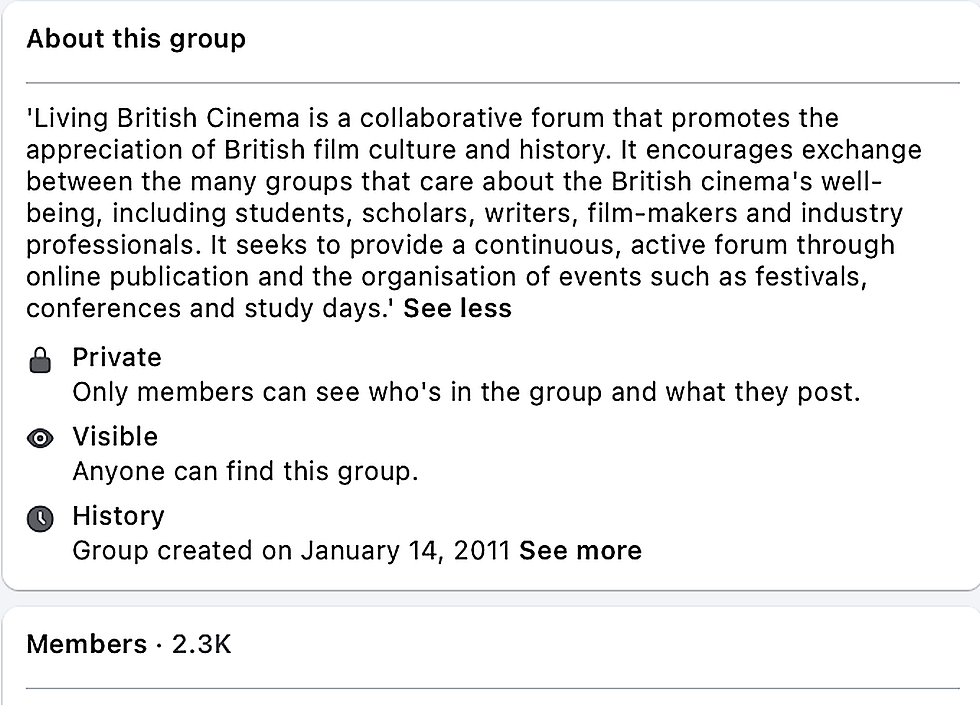
I hardly visited the site, but it was nice to know it was there and I even once or twice contributed a post. So I was taken aback one morning to discover that I was no longer a member, and could not get access because it had gone private. I reapplied to join and, after I had been left “pending” for several weeks, emailed one of the organisers.
“I was puzzled to find that somehow I had ceased to be a member of "Living British Cinema" forum,” I wrote. “I did apply to rejoin again some weeks ago (not that I thought I had left!), but my application still seems to be pending and I cannot see any posts. I would be very grateful if you could reinstate me!”
“Yes, we have actually stopped using the group,” the organiser replied. We’ve paused the group and are slowly removing members which is the only way to delete a group. We’re not using it now and as it is attached to our QMUL group, we felt it was time to let it go hence the reason. Others have similarly contacted me recently. It’s taking a long time to do, but we are removing all members.”
“I’m very sad to hear this,” I answered. “I remember that when Lucy Bolton and I proposed LBC back in 2010, the idea was that it should be an open forum that, to quote from our application to the University for funding, would “act as an interface between education, the public and the British film industry”.
“Living British Cinema itself is still ongoing,” she reassured me, but the Facebook Group had become just “a hub of spam”, so “it doesn’t feel the right platform to share our work anymore”.
“Thanks for explaining,” I replied. “A hub of spam is certainly not what one wants for a living British cinema!”
I didn’t take issue because the organiser – who was putting the finishing touches to a PhD – had much more important things to think about. But I thought it was a great pity to close a forum without warning or consulting its members. So much for “encouraging exchange between the many groups that care about the British cinema’s well-being”.
The British cinema is thankfully resilient enough not to have to rely for its survival on a Facebook group, but this little act of killing upset me because I had helped to give life to the thing.


