“How can I light them, if they move?”
Updated: May 30

The Daily Telegraph waxed lyrical recently about the post-war years as a supposed “Golden Age” of the British cinema. “The era’s consistent appeal lies in its application of controlled visual showmanship and moral ambiguity to even relatively mundane productions. Take The Fallen Idol, from 1948. What could have been a straightforward police procedural about a death in an embassy becomes an occasion for arresting visual experimentation.”
Well, let’s take The Fallen Idol. To suggest that it was a “relatively mundane production” is absurd. Its director, Carol Reed, was at the time widely regarded as Britain’s best director, and the film was adapted from a short story by one of the country’s leading novelists, Graham Greene. It was a glamorous, prestige production. It took many weeks to shoot and depended upon distribution in the United States, through the Selznick Releasing Organisation, to recover the huge cost of its production.
Any film starring the glamorous French star Michèle Morgan and theatre knight Ralph Richardson, who received his knighthood in the year that The Fallen Idol was made, was never intended to be a “procedural”. Its cinematographer was Georges Périnal, who had shot Jean Cocteau’s Le Sang d’un poète and René Clair’s Le Million in France, before Alexander Korda lured him to Britain. He went on to light the Charles Laughton biopic Rembrandt and, renowned for his painstaking perfectionism, had the attitude of a Rembrandt himself.
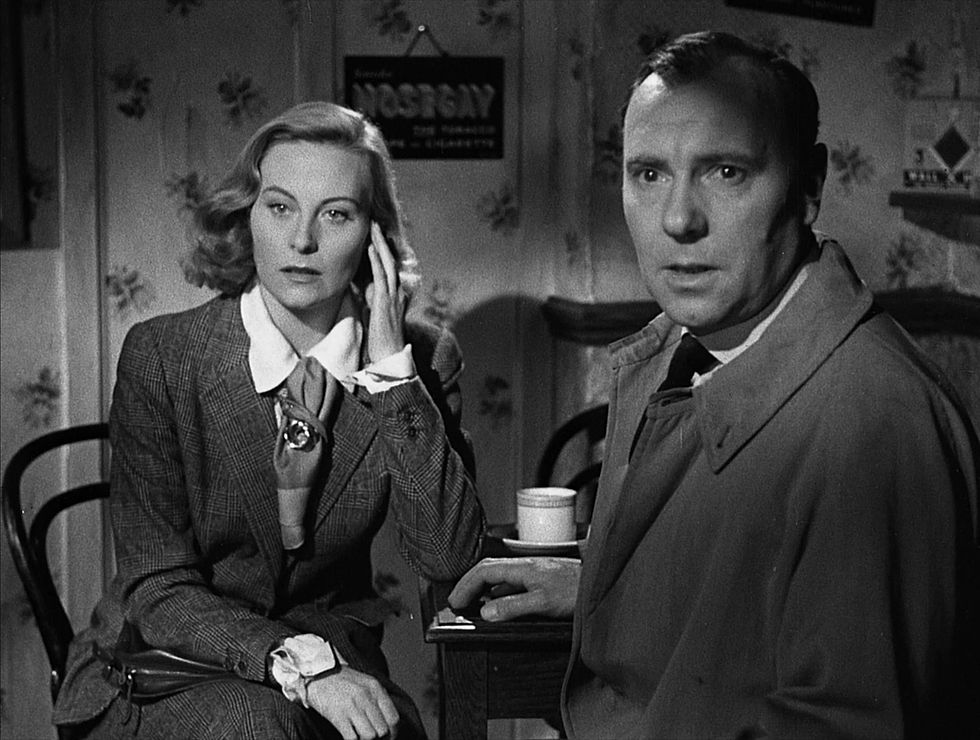
Guy Hamilton, who was Carol Reed’s assistant on The Fallen Idol, had a good story about what it was like to work with him. “Arresting visual experimentation”, for Périnal, meant keeping everything just as still as possible – the way that pictures were supposed to be before two other Frenchmen invented that annoyingly fidgety thing called the cinema.
“We were shooting a close shot of Michèle. Just before ‘turn-over’ Peri hops in, twists her face to the right, so as to catch one of his mini key lights, telling her to keep still and she will look beautiful. Carol hasn’t noticed any of this by-play because he is behind the camera having a nervous smoke. ‘Turn-over. Action!’ Michèle speaks her lines in a strangulated voice as she tries to look in one direction and speak in the other. Peri beams with pleasure. She is looking beautiful. ‘Cut! Michèle, dear, I know it’s difficult for you speaking lines in English, but just relax. Let’s try it again.’ Michèle relaxes but the moment Carol’s back is turned, Peri’s back again twisting her head around. ‘Tu es si jolie comme ça!’ We did about four takes, and poor Michèle Morgan didn’t know whether to say it is Peri who tells me to twist my neck like this. So I said, ‘Carol, watch. Peri leaps in at the last minute.’ So there’s a little bit of a row, which Carol easily wins, leaving Peri muttering Gallic curses. The climax came one day when Carol lined up a close two-shot and, in the course of the scene, one actor was to cross behind the other. Peri threw up his hands in disgust: ‘How can I light them if they move!’”
Somehow the film got finished and, if any film deserves to be called a masterpiece, The Fallen Idol is surely a contender. Carol Reed was clever enough to give the boy a paper dart, which helped to keep it moving. But the film was a complete exception to the generality of post-war British production, which does not live up to the Daily Telegraph’s rose-tinted assessment of that time. But then nor do British films of today deserve to be as casually dismissed as they are in the Telegraph article. In every age you will find the good, the bad and the ugly. Even ours.


