Rewriting The Red Shoes (Step 3)
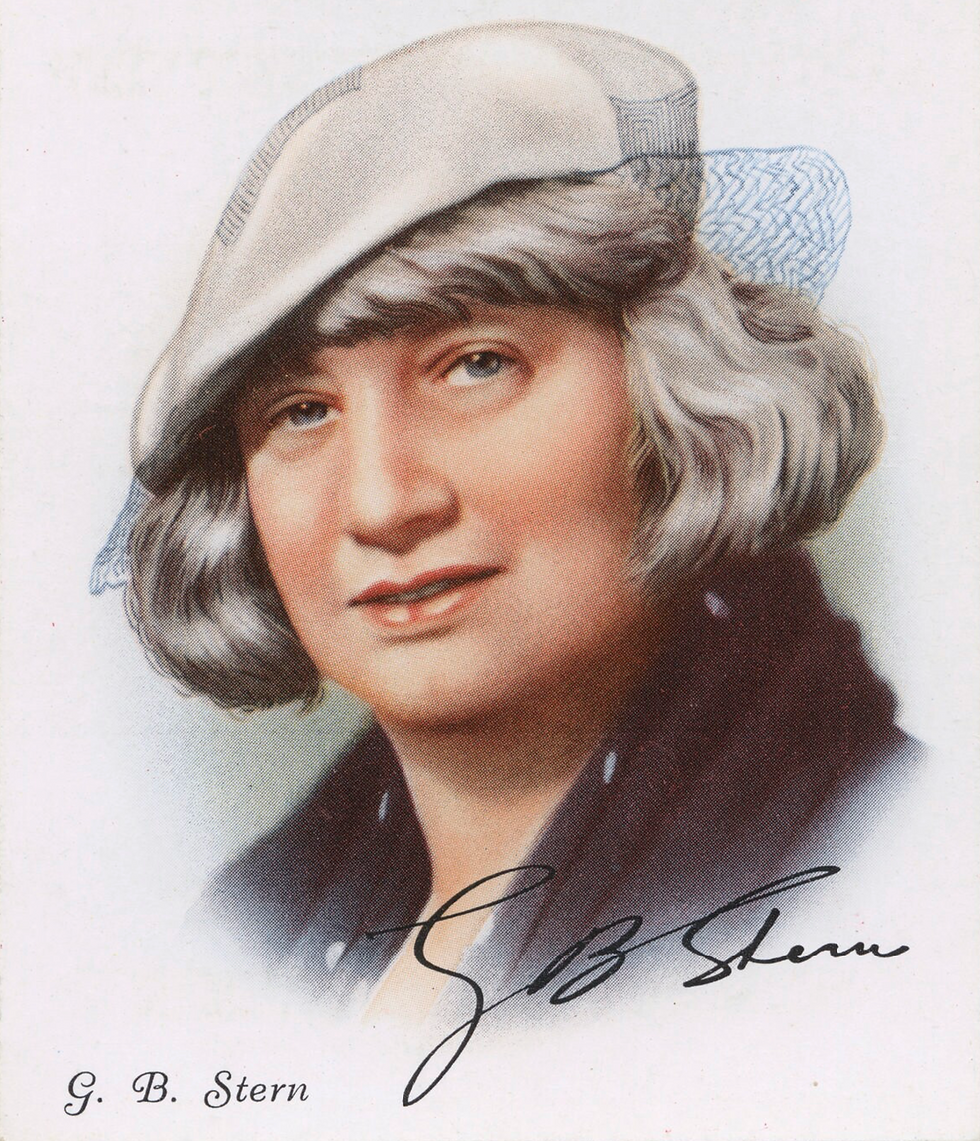
The first script of the ballet story by G. B. Stern – which Korda had hoped but failed to put into production in 1937 – can be thought of as the “Tamara” version, drawing as it did on the life of the Ballets Russes dancer Tamara Karsavina, who in 1918 married the British diplomat Henry James Bruce.
Here is a brief synopsis:
A young English girl, Lalage Maitland (although her name would change in later drafts), falls under the spell of her Russian grandmother who was once a prima ballerina with the Imperial Russian ballet. The grandmother wants to turn Lalage into a great dancer. She makes her swear not to put love before her dancing. But then Lalage falls in love with a young British diplomat called Anthony Brightworld, whom she secretly marries. Her grandmother whisks her away to Monte Carlo to dance for the ballet company of famous Russian impresario Reslov. After becoming a great success in a new ballet inspired by the Hans Christian Andersen fairytale The Red Shoes, Lalage renounces her life as a dancer and chooses to return to Anthony. “You very nearly ruined my life,” she chides her grandmother. “I’m through with the ballet! I hate it! ... Now I’m going to live again. I’m going to be free – free for Anthony!”
In this first version, The Red Shoes was only a peripheral part of the story, which was ultimately about a young woman who resists the spell of the Red Shoes. It was a time when the Happy Ending stilled ruled. The script was put aside in the summer of 1937, because Korda did not think its shortcomings could be sorted out before Merle Oberon, who had only limited availability, had to return to Hollywood.
But while Oberon was away, Korda asked G.B. Stern to work on another draft of the script. Dated March 1939, this second version went off in a very different direction as Stern turned a fictionalized account of Tamara Karsavina’s life into a fictionalized version of Merle Oberon’s, bringing that life up to date.
With The Divorce of Lady X, which opened at the Odeon Leicester Square in January 1938, Oberon had begun an on-screen partnership with Laurence Olivier that anticipated their appearance together in the hugely successful Goldwyn version of Wuthering Heights the following year. At about the same time she had become involved in a romance with Korda that led to their eventual marriage in the summer of 1939.
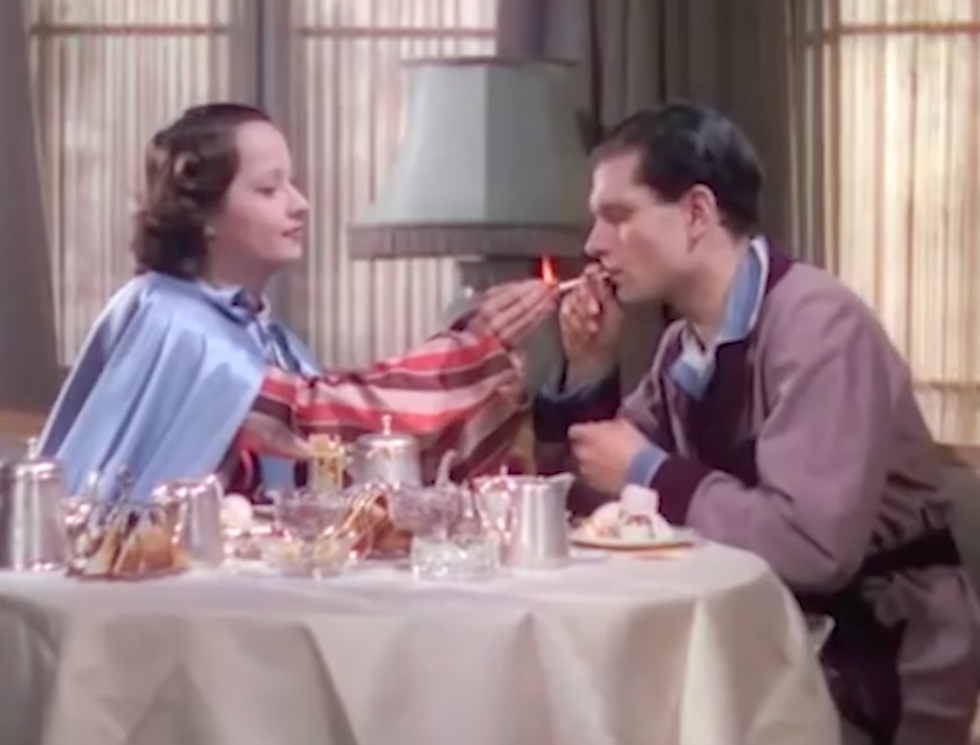
Dated 15 March 1939, Stern’s new script incorporated both these situations. Several of its story and character elements would be very familiar to anyone who has seen Powell and Pressburger’s The Red Shoes, which would open nearly a decade later.
In the second Stern version, let’s call it the “Merle” version, the Grandmother is no longer the dominating figure in the young dancer’s life. Instead, that figure is now the impresario. Called “Reslov” or “Rostov” in the earlier Tamara drafts, in the Merle version the character becomes “Konstantin”. He is clearly modelled on Korda, while the young ballerina herself is now explicitly called “Merle”. Konstantin offers to turn Merle into a great dancer in a similar way to which Korda had already turned the real Merle into a great movie star.
The Merle version of The Red Shoes also introduces into the story the idea of the Romantic Triangle. It was a situation that could be found in the Nijinsky–Diaghilev–Romola de Pulszky relationship that first gave Korda the idea to make a ballet film for Oberon back in 1934, but also in the showbusiness headlines of 1939. Among Merle Oberon’s disappointed suitors when Korda finally won her hand that year was Wuthering Heights co-star David Niven.
But it was the on-screen romance of Oberon and Olivier – begun in Lady X, then continued in Wuthering Heights – that receives a conscious nod in Stern’s treatment, even if in reality the two stars had fallen out badly during the making of the Hollywood film.
After Merle joins Konstantin’s ballet, we are introduced to a new character, Larry, a minor violinist in Konstantin’s orchestra, but also a brilliant if undiscovered young composer. Konstantin invites him to replace the chef d’orchestre who has resigned. Larry falls in love with Merle, tears up all his other music, and writes The Red Shoes ballet only for her to dance.
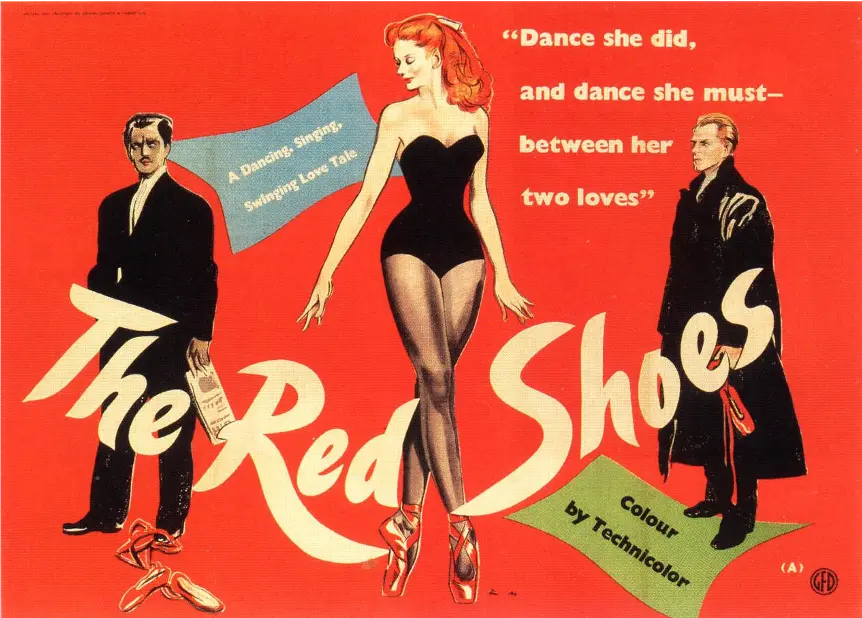
Larry and Merle get married but without telling Konstantin. Thinking that Merle has become complacent about her dancing, Konstantin insists that she come and stay in his house, where he can make sure she devotes her entire time to dance. When Larry reveals that he and Merle are married, Konstantin fires him, telling him that The Red Shoes will never be performed. “There are some ballets which have been bought but still never get performed. One praises them, one sincerely admires them, even, but they are lost like the lost tribes.”
Konstantin then uses his Svengali-like hold over Merle to make her stay with his ballet company. Under his tutelage she becomes a great dancer, but it is at the cost of her private life. Finally, something in Merle snaps. She leaves Konstantin’s ballet and returns to Larry, who has now become a successful composer in America. “I will not attempt to keep you back,” Konstantin tells her. “In fact, I have lost interest in you already.”
It is from this point that Stern’s Merle version loses its way, as it takes the path of a conventional 1930s happy ending. Renouncing their careers, Larry and Merle retire together to the south of France. But quietly they each nurture their passion for music and dance. Larry tells Merle he is writing another ballet for her to make up for the loss of The Red Shoes.
Meanwhile, Konstantin’s ballet company, which never recovered from the blow of Merle’s departure, collapses. When Larry learns of Konstantin’s ruin, he invites him to produce the new ballet he has been writing. In a spirit of reconciliation, Konstantin offers to return the ownership of The Red Shoes to Larry so that at last it can be performed, but Larry dismisses it as a piece of juvenilia. “It’s quite nice, but too much trick work, too slight and wistful; the composer didn’t know his job yet.”
Putting The Red Shoes aside, the composer, ballerina and impresario – Larry, Merle and Konstantin – now devote themselves to the new work. We never find out exactly what his new ballet is about, but Larry declares, “This is to be for the people, not for the box-holders. Inspiring... Easily accessible.”
Stern’s script ends not with a bang but an insipid whimper. The last lines are: “A slow FADE OUT while they discuss and argue and plan the future, passing the pages from one to the other, a re-united trio ready for their work, determined that it shall be good, caring for nothing else.”
And this is where Stern fades out and Pressburger finally takes over.
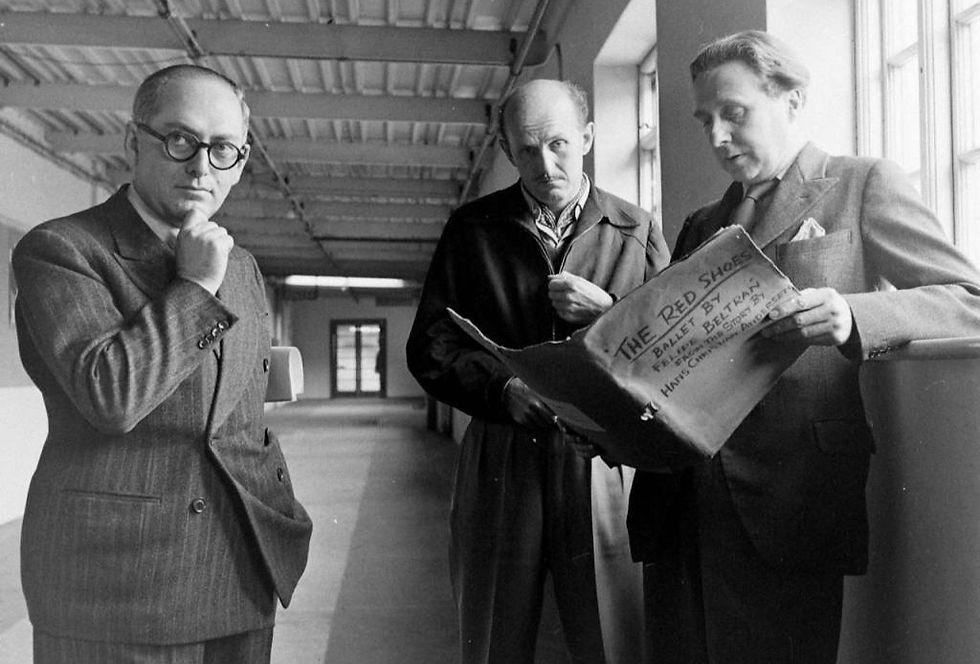
According to Emeric Pressburger: The Life and Death of a Screenwriter, the biography written by his grandson Kevin Macdonald, Emeric Pressburger was employed by Korda at the beginning of May 1939 to write “a completely fresh story and screenplay”. Macdonald describes a meeting in which Korda briefed the screenwriter on his new assignment. He quotes his grandfather’s own recollection of it:
I remember the meeting well. “Emeric,” he said to me, “I want to make a film with Merle based on the ballet. I have already asked several people to write it and nobody has got it right.” There was no story at all except that Alex had the idea of basing it on the Hans Andersen tale, “The Red Shoes”, which is a great favourite for children in Hungary. I was rather puzzled that he wanted Merle to be in the film, I don’t think she had ever taken a single ballet lesson in her life. But, of course, I didn’t say anything.
This account raises more questions than it answers, because Pressburger’s recall of what happened departs so significantly from the known facts. First, it is not true to say that there “was no story at all” beyond the idea of basing it on the Andersen tale. There were the two versions of the ballet story that G. B. Stern had written. There was also the stage adaptation of Romola Nijinsky’s biography of her husband that the New York theatre impresario Sam H. Harris had commissioned Keith Winter to write in 1934. Pressburger was therefore able to draw on a substantial body of pre-existing material. Secondly, it was wrong to say that Oberon had never taken “a single ballet lesson in her life”. She had taken many lessons when The Red Shoes had very very nearly been put into production in the summer of 1937.
Macdonald states in his book that Korda then sent to his grandfather the previous efforts of the other writers with this note:
Script, “Ballet story”, G.B. Stern.
The whole of this wad of material – the result of much hard work and (doubtlesss) innumerable story conferences, is a mess. The story is no longer a ballet story. The dialogue is awful. The characterisation is non-existent, the [unreadable] inept.
I should throw it away.
Alex
Macdonald’s account suggests that this undated note was written in the early summer of 1939 after Korda and Pressburger had their meeting to discuss their assignment. But my own research in the Emeric Pressburger Papers at the British Film Institute makes me doubt that this can be true.
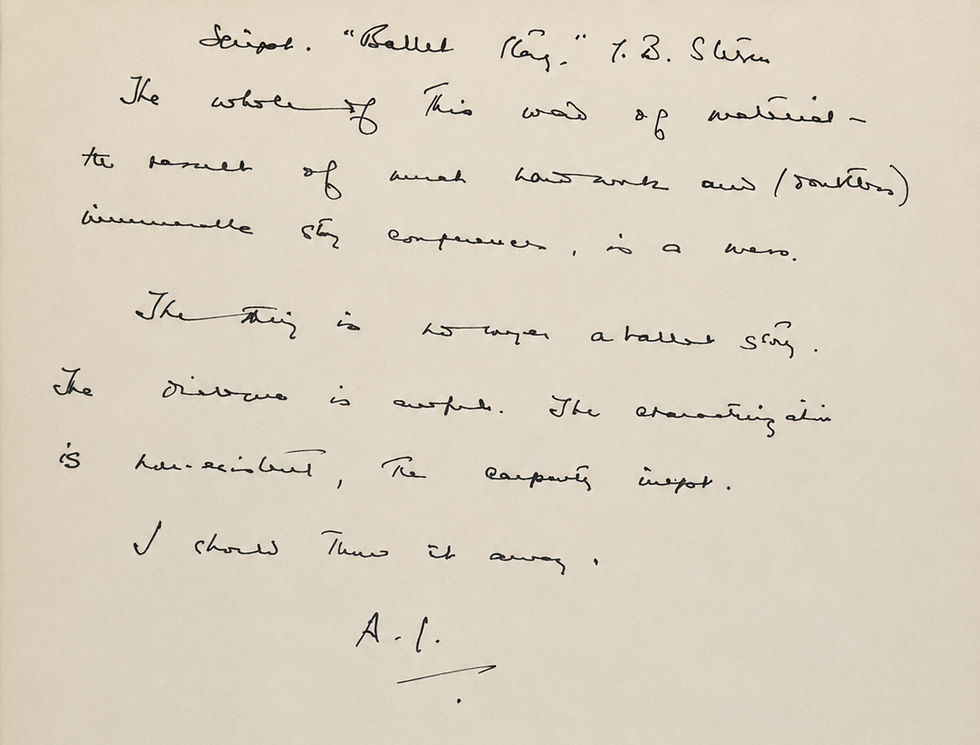
I found the note (the “unreadable” word is “carpentry”), but it was attached to a folder of G.B. Stern's various scripts and treatments (no one else’s), which was labelled “Property of ALEXANDER KORDA, 1040 N. Las Palmas, HOLLYWOOD, Calif”.
As Hollwyood was where Korda was based between 1940 and 1943, I think it is much more likely that he wrote the note not before the outbreak of war in 1939, when he had employed Pressburger to work on his ballet project, but during the war after he had finally given up on The Red Shoes and sold the film rights to Powell and Pressburger. The note then becomes a typical piece of Korda irony, as he advises Powell and Pressburger to throw away a property that he has just sold to them for a considerable amount of money – although of course Powell and Pressburger would eventually have the last laugh.
The other puzzle is quite what happens when Pressburger is still a writer on Korda’s payroll working on the project over the summer of 1939. According to Macdonald, he began with background research, spending several weeks sitting in on rehearsals of Fokine’s ballet Paganini, which premiered at Covent Garden on 30 June 1939. He was then “assigned a collaborator to work with him on the dialogue”.
As that collaborator was Keith Winter, who had in 1934 been commissioned to adapt Romola Nijinsky’s biography of her husband, I think it is likely that Winter provided far more to the project than only dialogue. But Macdonald’s account makes Winter seem little more than a glorified secretary: “Keith Winter was a young playwright and novelist. He recalled that they worked together for about a month. Emeric dictated characters, scenes, actions and shots, while Winter took notes.” But what about Winter’s work on the theatre adaptation of the Nijinsky biography? Surely this must have fed into the collaboration? I would love to find out whether any documentary evidence still exists to shed light on the matter.
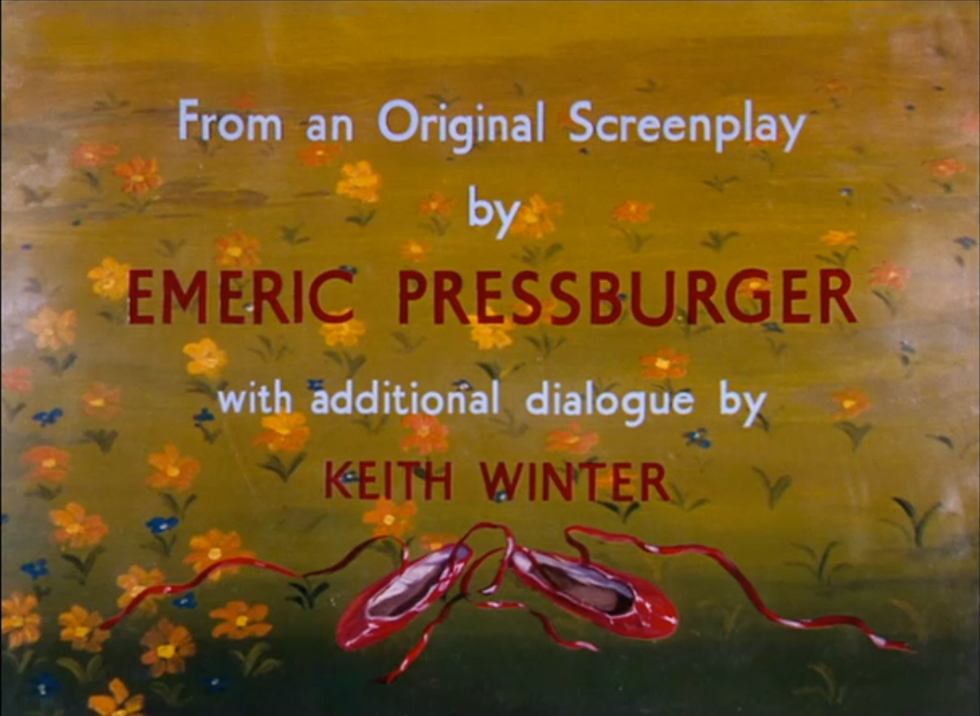
In the meantime, fairness requires the observation that, although the credits of Powell and Pressburger's Red Shoes state that the film is “from an Original Screenplay by Emeric Pressburger with additional dialogue by Keith Winter”, this is not true. It is an extremely accomplished screenplay by Emeric Presburger which greatly improved the previous work of G.B. Stern, but that work by Stern, none the less, provided much of the substance of the final film. The fact that she is not mentioned at all in the credits seems to me to be one of those injustices that so often occur to writers who work for hire without any copyright protection.
Keith Winter is presumably credited because he did retain his copyright, which Powell and Pressburger therefore had to respect. It’s interesting that when many years later, in the 1970s, Powell and Pressburger were considering the possibility of a Broadway production of The Red Shoes, Powell wrote to Pressburger, “we will have to prove ownership of Keith Winter copyright now and in the future”.
Quite exactly what that Winter copyright amounted to in terms of specific material remains a mystery that I would love to solve one day. But for now it remains only to stress the essential insight that Pressburger brought to the venture – that little bit of magic that made all the difference – which was, simply, to realize that nothing matters but the red shoes.
G.B. Stern had put so many of the correct story elements in place. But where she went wrong – consistently from her first draft to the very last – was to imagine that she could tame The Red Shoes. Pressburger knew that there could be no limit, no compromise, no happy ending. The Red Shoes can never be tamed. They must dance on from the first frame to the very last.
For the previous instalments of this piece, see Rewriting The Red Shoes Step 1 and Step 2.