Rewriting The Red Shoes (Step 2)
- Charles Drazin
- May 4
- 5 min read

These Three!
Merle Oberon’s swift rise to Hollywood stardom began here. Published in the Daily Herald on 25 October 1933, the photograph above was taken the previous night at the premiere of The Private Life of Henry VIII at the Leicester Square Theatre in London. Hailed in its time as the greatest British film ever made, the film turned Korda into the country’s most famous producer, won Charles Laughton an Academy Award, and gave Oberon a brief but show-stealing role as a queen about to be executed.
These three! Here was a team that could go places. Korda planned to build on Laughton’s extraordinary acting talent by featuring him in some more historical roles: the painter Rembrandt, the Roman emperor Claudius and the Russian ballet impresario Sergei Diaghilev. But during the production of Rembrandt in 1936, Korda fell out badly with his star. When it was time to film the ill-fated “epic that never was”, I, Claudius, the relationship had become so poor that Korda hired Josef Von Sternberg to direct Laughton in his place.
“When I asked him why he did not wish to direct this film himself,” Sternberg recalled, “he gave me gruesome details of the difficulties he had endured in directing Laughton, interlarding his recital with effusive flattery of my ability to direct the devil himself.” Korda had not been exaggerating. Even Sternberg – a disciplinarian who lived up to his name – could not control Laughton. Directing the actor, Sterberg recalled, “was not a nightmare, it was a daymare”.
Well before I, Claudius was abandoned in mid-March 1937, Korda realized that it was no longer realistic to expect Laughton to play Diaghilev. His plan for a screen adaptation of the book about Nijinsky by the dancer’s wife Romola was therefore quietly dropped (a disappointing adaptation finally reached the screen in 1980). Instead, he decided to re-imagine a ballet story that could be built around Merle Oberon. Having won an Oscar nomination in 1936 for the Sam Goldwyn production Dark Angel, Oberon went on, according to The New York Times, to give “her finest performance to date” in Goldwyn’s “exceptionally fine picture” These Three. She was now Korda’s most valuable box-office asset.
“Lester Cohen working on story for Merle Oberon called Tamara in which she plays the part of a great Russian ballet dancer,” Korda cabled Goldwyn on 17 February 1937. The film would be one of the very first British features to be made in the expensive new process of 3-strip Technicolor. As Korda had only a half-share in Oberon’s contract, there was huge pressure on him to prove that he could provide roles for his ambitious star in Britain that were just as appealing as Goldwyn’s Hollywood ones.
The dramatic focus for the ballet story was to be no longer the relationship between Nijinsky and Diaghilev, but instead the life of Tamara Karsavina, principal ballerina of the Ballets Russes, who had married an English diplomat, Captain Henry James Bruce, and, having escaped from revolutionary Russia, settled down in London.

The vestiges of that relationship can be traced in Powell & Pressburger’s The Red Shoes. The Russian prima ballerina, Irina Boronskaja, leaves Lermontov’s ballet company to get married. Her fiancé (played by Cecil Ramage), whom we see briefly behind the wide brim of her hat as she says goodbye to her friends at the Gare de Lyon, is described in Pressburger’s script as a “good looking Englishman of about 40” – only a little older than Henry Bruce was when he married Tamara Karsavina in Petrograd in 1918.

But nothing in Korda’s world was ever plain-sailing. Soon after Cohen arrived in London, the mogul took him off the ballet story and put him to work instead re-writing scenes for I, Claudius. “The Claudius scenario is a great joke,” observed an amused Robert Graves, the author of the original novel. Having himself contributed an unused draft of the script, he correctly concluded: “Films are insane: if they occasionally drop gold on our hats as we pass, that’s all right.”
Korda entrusted the ballet story instead to Gladys Stern, a then well-known British novelist who – with a conscious Shavian touch – published her books under the name “G. B. Stern”.

During the spring of 1937, the Daily Mirror journalist Godfrey Winn visited Stern in her Albany flat, where she was writing the first draft. He was surprised to find her still in her pyjamas: “The film director with whom she is working, Ludwig Berger, arrives so early for their conference every day that she hasn’t time to dress!”
Korda had hired not only Ludwig Berger but also the producer Günther Stapenhorst. Together the two men had, in 1933, made, for the German studio UFA, a very successful musical comedy, Walzerkrieg (“Battle of the Waltzes”). By a very Red Shoes twist of fate, one of the stars of Walzerkrieg – playing the part of the composer Johann Strauss – happened to be a young Anton Walbrook (then known as Adolf Wohlbrück), the future Boris Lermontov.

“The plot is very hush-hush at the moment,” Winn noted in his piece for the Mirror. “But I can tell you this. They start shooting on the floor at Denham on June 6, and Korda says he has never been more pleased with a script.” It was an optimistic date. Korda wasn’t quite as pleased with the script as he claimed. More time was needed to get it right, and he certainly didn’t want a repeat of I, Claudius, which – with its various problems unresolved before it went into production – ended up being abandoned at great cost. The start date of the ballet story was therefore put back by a few weeks to July.
It was about this time that the original title, “Tamara”, was changed to “The Red Shoes”. The fan magazine Picturegoer mentioned the forthcoming production in its 10 July 1937 issue: “These shoes may be almost literally called a vehicle,” it wrote, “for the title is derived from an old legend of a girl who wore red shoes which made her dance unceasingly.” Returning to the subject the following week, the magazine pointed out the significance of the film being shot in Technicolor: “We shall be able to see for ourselves that the shoes are red without having to take Mr Korda’s word for it.”
Merle Oberon had been a professional dancer before she became a movie star: in the late 1920s she had worked as a dance hostess at the Café de Paris. The intensive training that the new role now demanded offered an excellent publicity opportunity that led to a feature in The Sketch:
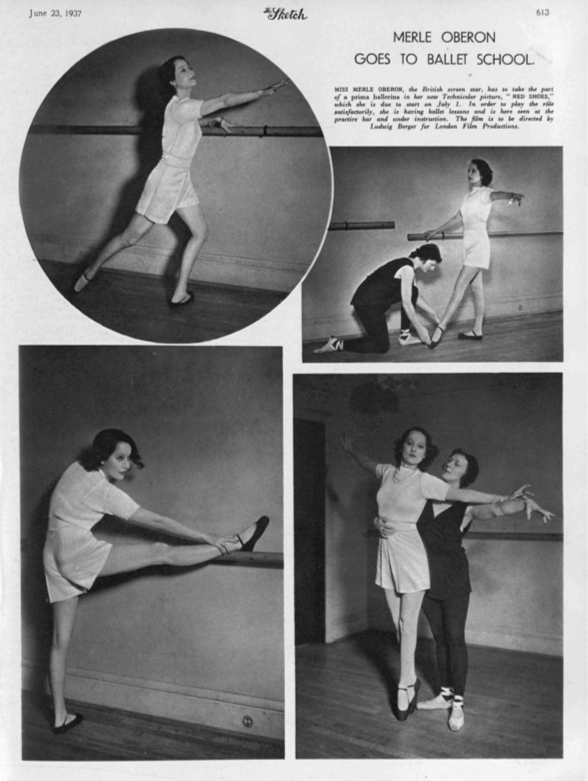
It’s difficult to tell from the black-and-white photographs whether Merle was wearing red shoes – those shoes that Lermontov in the Powell & Pressburger film says are “never tired” – but no matter how hard she worked, it wasn’t enough to prevent the scripting problems from delaying the start of shooting once again. To keep his star happy, Korda quickly put her into another expensive Technicolor production, the romantic comedy The Divorce of Lady X, which went on the floor at Denham on 26 July 1937. It gave Oberon the chance at last – as she put it in a letter to Goldwyn – “to look ravishing with divine clothes”.
Meanwhile G.B. Stern continued to work on the ballet story . . .
To be continued.


