The Young Oliver Sacks

This picture is familiar yet strange to me. The reproduction of the Henri Rousseau painting The Snake Charmer, which was bought from Ryman & Co in Oxford High Street only shortly before the photo was taken more than seventy years ago, now hangs on one of my walls. I recognise too from my childhood the metronome on the right-hand side of the mantelpiece, and the shot glass on the left, which in my memory was cobalt-blue with gold filigree. And I think that the rectangular object – on the other side of the dish from the metronome – must be my father’s old travelling chess set.
I have never been in that room but it was where my father, David, lived for a year when he was studying at Oxford, and the young man in the picture was his friend and then flatmate, who would many years later become famous as the neurologist and writer Oliver Sacks.
Shortly after my father died in 2014, my brothers and I received this letter of condolence:

I thought it was a very nice, thoughtful letter to write. Modest and unassuming is exactly what my father was, certainly too modest to tell his children that he had once played the Cimarosa Oboe Concerto with Oliver – although I think it must have been a clarinet that he played it with, not an oboe, for a clarinet was the instrument that my father certainly did stay with.
I have never met Oliver, but everything I have learned about him makes me think of him with great affection. His family were witnesses to some important life and death moments in mine. His doctor father, Samuel, signed the death certificate of my great grandfather, Hyman, while his obstetrician mother, Muriel, brought my father into the world (and his two brothers).

The idea of the two friends together in that flat reminds me of Les Enfants Terribles. Just as my father took pictures of Oliver, Oliver took pictures of my father, including this one of him attempting to blow a smoke ring. At some point my mother turned up from Ireland to disturb the dynamic. Looking through her old diaries, the first mention I can find of Oliver is an entry for Saturday 12 July 1952: “Went to Oliver’s party with David. Happy as can be.”
I have no means of making any reliable judgement, but I often wonder whether my mother and Oliver saw each other as rivals. She used to reminisce about his great strength. She described how one day he swam in the River Cherwell, pulling behind him the punt that carried her and my father. The image she gave was of a kind of defeated Heracles.
It was a pose that he carried into my parents’ wedding album, where he can be seen standing in the background with my uncle Michael (who would also leave England for the New World).
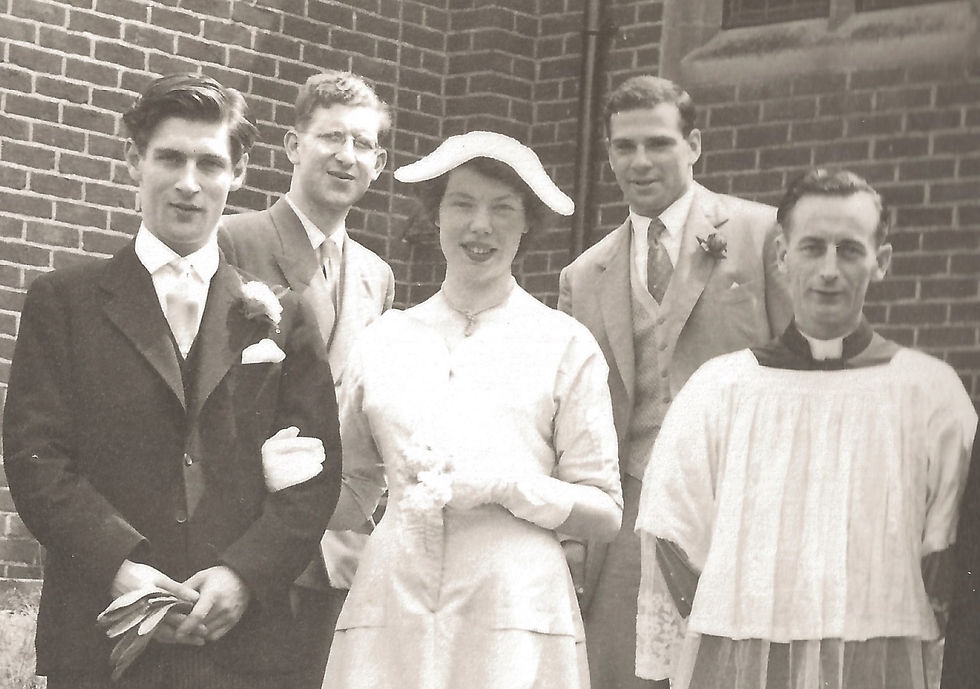
I thought of my mother’s Oxford reminiscences when last year I read a piece about Oliver by Rachel Aviv in the New Yorker. It presented him as a closet gay who sublimated his nature until the publication of his book Awakenings.
He described its publication as his own “Great Awakening”, the moment he “came out”. The article quoted from Oliver’s journal: “It seems to be surely significant that ‘Awakenings’ finally came forth from me like a cry after the death of my own mother.” In his autobiography On the Move, he decribed his mother’s reaction to the discovery – shortly before Oliver went up to Oxford – that her son was homosexual: “You are an abomination. I wish you had never been born.”
That’s quite a curse for an obstetrician – not easy for a son to carry through his life. So I like to think that maybe my father, who, after all, had Oliver’s mother to thank for being born, was able to play some small part in Oliver’s eventual self-realisation. Certainly he was able to facilitate Oliver’s thirst for the limelight when one day they went down to the psychology section of the Radcliffe Science Library for a photoshoot.
All the exposures on the roll were of Oliver. The one below, cropped to leave out the desk and the door, is the first picture that appears in On the Move.

But the one I like most, towards the end of the roll, gives some sense of the labour that went into the making of the image. I can imagine the precision and care with which my father would have set everything up. I like too the strange synchronicity of the equipment that can be seen on the table – Oliver’s memoir of his childhood was called Uncle Tungsten, after his uncle David who ran a lightbulb factory.

Their respective roles that day – my father behind the camera and Oliver in the light – were true to how they would go on to live their lives. I suppose that “long, unexpected letter out of the blue”, which Oliver received only a year before my father died, must still exist somewhere. But remembering how private he was, I’m content only to imagine what it said.


